Jonas Becker · 29 September 2026
Analyzing UV Resistance in Decorative Planters for Arid and Humid Transition Zones
Transition zones between arid and humid climates present unique challenges for decorative planters because intense solar radiation combines with fluctuating moisture levels to accelerate material breakdown. Researchers have documented how ultraviolet light penetrates polymer structures in planters made from polyethylene, polypropylene, and resin composites, leading to chain scission and surface chalking over time. Data from field monitoring programs shows that planters in these regions often experience temperature swings of 30 degrees Celsius or more within a single day, which compounds UV-induced embrittlement when humidity spikes follow prolonged dry periods.
Material Composition and Degradation Pathways
Manufacturers formulate decorative planters with varying levels of UV stabilizers such as hindered amine light stabilizers and carbon black additives, yet performance differs markedly across product lines. Studies conducted across the American Southwest and similar zones in Australia indicate that high-density polyethylene planters retain structural integrity longer than polyvinyl chloride alternatives when exposed to cumulative UV doses exceeding 200 megajoules per square meter. Observers note that ceramic and concrete planters resist UV fading better than plastics but remain vulnerable to micro-cracking when thermal expansion occurs alongside moisture absorption during humid episodes.
One research team tracked planter samples over 18 months in central Texas, where annual UV exposure averages 6500 hours of direct sunlight, and recorded color retention rates above 85 percent only in products containing at least 2 percent UV absorber by weight. Those findings align with accelerated weathering protocols that simulate five years of outdoor exposure in roughly 2000 hours of laboratory testing.
Testing Protocols and Standards Application
Standardized methods such as ASTM G155 and ISO 4892 outline xenon arc and fluorescent UV lamp procedures that replicate the spectral power distribution of sunlight while controlling temperature and humidity cycles to mimic transition zone conditions. Engineers apply these protocols to measure tensile strength loss, impact resistance reduction, and surface gloss changes after defined exposure intervals. Figures from collaborative trials released in 2024 reveal that planters rated for moderate climates lose up to 40 percent of their original flexural strength after equivalent three-year UV exposure, whereas formulations optimized for high-UV zones maintain over 70 percent strength retention.
Regional Data and Transition Zone Variables
Climate records from the National Oceanic and Atmospheric Administration document that areas like the Texas Hill Country and parts of northern New South Wales experience distinct seasonal shifts where dry winters give way to humid summers, increasing both UV dosage and hydrolytic stress on planter materials. Researchers have observed that water vapor present during high-humidity intervals can penetrate micro-voids created by prior UV exposure, accelerating internal degradation through combined photo-oxidation and moisture-induced swelling. In September 2026, an international consortium plans to publish expanded datasets incorporating satellite-derived UV index readings paired with ground-level humidity measurements from 12 transition zone sites worldwide.
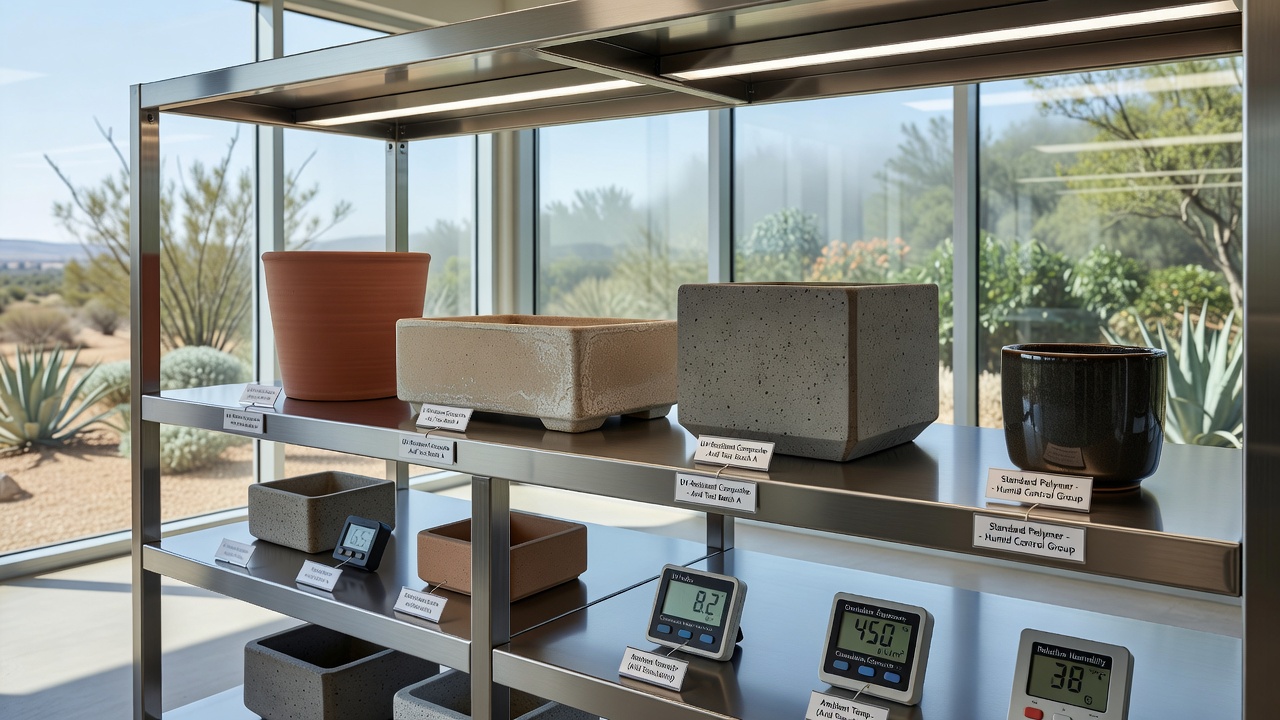
Comparative analysis between arid-dominant and humidity-dominant sub-zones within the same geographic corridor shows that planters positioned in full sun on reflective surfaces accumulate 25 percent higher UV energy than those placed in partial shade, leading to faster surface erosion. Manufacturers now incorporate region-specific labeling that references cumulative UV exposure maps rather than simple climate classifications, allowing specifiers to select products with appropriate stabilizer packages.
Performance Metrics and Long-Term Monitoring
Longitudinal studies track planters through multiple annual cycles using metrics that include retained elongation at break, color difference values measured via spectrophotometer, and visual inspection for crazing or warping. Data compiled by materials laboratories indicates that planters containing titanium dioxide pigmentation exhibit slower chalking rates compared with organic pigment systems, although the inorganic approach can increase material stiffness. Those who maintain monitoring stations in transition zones report that regular cleaning to remove dust and pollen reduces localized hot spots that otherwise magnify UV absorption.
Industry reports from research institutions across North America and Europe emphasize the value of third-party verification programs that certify UV resistance claims under standardized conditions. Such certifications help landscape professionals match planter specifications to projected service life expectations in areas where annual UV radiation exceeds 5000 hours while humidity varies between 20 and 85 percent.
Conclusion
Effective analysis of UV resistance in decorative planters for arid and humid transition zones requires integration of material science data, regional climate records, and standardized weathering test results. Continued monitoring through 2026 and beyond will refine selection guidelines as new stabilizer technologies and updated exposure models become available, supporting more reliable product performance across these variable environments.